
 One Platform for Collaborative IntelligencePeople, AI teammates, knowledge and systems working together in one governed environment.Platform Overview →
 From 20 to 1,400 users in 7 monthsAt Lactalis, each deployment simplifies and accelerates the next.Read customer stories →
 We believe the future of work is collaborativeWe align people, AI teammates, and enterprise systems to execute together.Discover →
80% of employees say AI makes them faster. So why is EBIT flat?
80% of employees feel faster with AI, yet only 37% of companies see any EBIT impact (McKinsey, 2026). What the top 6% do differently.


McKinsey’s latest global report, “The State of AI in 2026: On the Road to ROI,” just revealed the numbers every executive was quietly dreading.
- 80% of employees say AI has boosted their individual productivity.
- Yet only 37% of organizations report any EBIT impact at all.
Read that comparison twice.
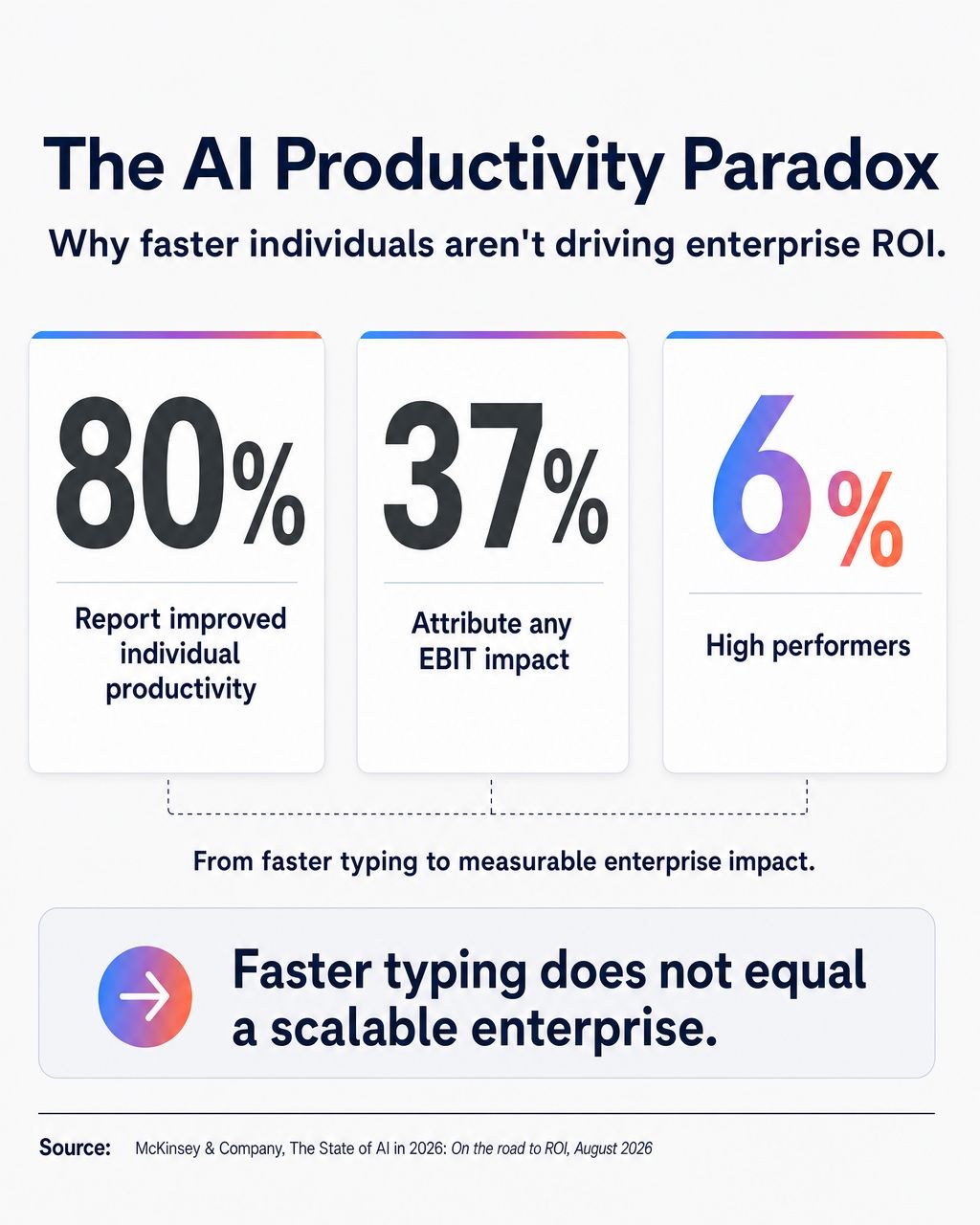
Faster employees, flat profitability
Over the last 24 months, enterprises poured millions into personal copilots and chat tools. Employees are drafting emails faster, summarizing PDFs quicker and writing code in seconds.
So why is enterprise profitability completely flat?
The Wave 2 trap
We mistook individual speed for enterprise execution.
Here is what happens when you roll out 5,000 isolated AI chatbot logins:
- You speed up isolated tasks, not cross-functional workflows.
- Critical knowledge gets locked inside private chat histories.
- Your teams become more fragmented, not more aligned.
- You create “AI fatigue” while token bills quietly compound.
What the top 6% do differently
According to McKinsey’s survey of global business leaders, only 6% of companies qualify as “high performers” seeing significant bottom-line gains (more than 5% of EBIT).
They don’t just sprinkle chatbots on top of existing processes. They fundamentally redesign how work gets executed. They are moving to Wave 3: Collaborative Intelligence.
Wave 3: Collaborative Intelligence
Instead of an employee whispering prompts to a solitary chatbot:
- Cross-functional teams collaborate with specialized AI Mates in shared workspaces.
- Everyone, human and AI, operates from one governed, sovereign enterprise context.
- AI handles intensive data orchestration; human judgment drives the outcome.
- Execution history compounds into an uncopyable enterprise moat.
Faster individuals do not equal a scalable enterprise. If your AI strategy ends at “everyone gets a personal chatbot,” you haven’t transformed work… You’ve just subsidized faster typing.
Over to you
Is your organization feeling this gap between individual AI usage and bottom-line EBIT?
Explore the operating model built for real enterprise execution.
Source: McKinsey & Company, “The State of AI in 2026: On the road to ROI” (August 25, 2026).
More from the newsroom
All news




See Collaborative Intelligence at work in your organization.
Our team will walk you through how governed AI teammates take on your most critical processes, from first use case to enterprise scale.

